
|
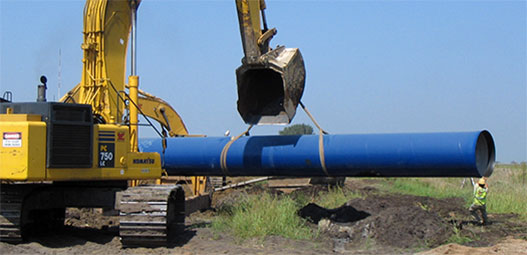
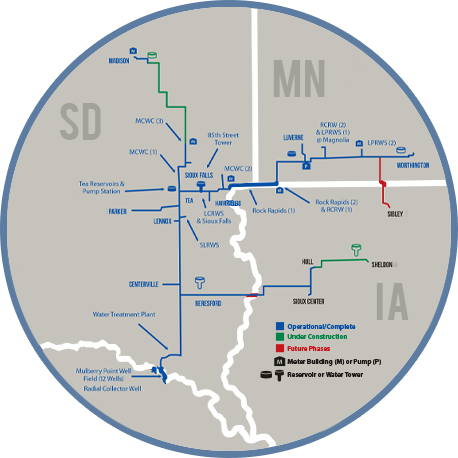
The Plan  Lewis & Clark will provide treated water to its member municipalities and rural water systems. When completed, the System will provide safe, reliable drinking water through its members to over 300,000 people in South Dakota, Iowa, and Minnesota. Lewis & Clark's member systems will use this new source of water to either replace or supplement existing sources of supply. Through careful engineering analysis, the Missouri River was determined to be the most viable source of water for Lewis & Clark. Utilizing a series of wells to tap into an aquifer adjacent to the Missouri River near Vermillion, SD, the System will distribute treated water through 337 miles of pipeline to members in a roughly 5,000 square mile area, which is the size of Connecticut. In addition to a traditional lime treatment facility, the non-looped System will also include a series of pump stations and reservoirs. The water treatment plant will be located three miles north of Vermillion. Depending on federal funding levels, construction is estimated to be completed around 2019. The maximum capacity from the completed system will be 45 million gallons per day (MGD). The maximum capacity represents less than 3/10th of 1% of the average daily flow of the Missouri River. For more information on the technical aspects of the project, see the Final Engineer Report under the Technical Information link. Lewis & Clark will improve the quality of life for area residents by addressing water quality, supply and infrastructure problems. In addition, it will stimulate the regional economy for years to come. Besides the obvious long-term growth potential to its members, Lewis & Clark will have a positive impact on the local and regional economies during construction. Based on the federal component of project expenditures, it's estimated that the economic impact to the region from construction of the project will total $374 million, which includes the creation of 3,730 construction related jobs over the lifetime of the project. These jobs will mean a direct labor income of $10.2 million annually to a region with an annual median income of $37,814. Tax revenues generated from construction are expected to be $15.9 million. The direct, indirect and induced impact of the operation and maintenance of the facilities after construction is estimated to be over $7 million annually for the region, creating 74 permanent positions. For more information on the economic impact to the region, see the Economic Impact Study under Technical Information link.
|